
AI diagnostic platform for medical imaging
A diagnostic platform that analyses medical images and patient data to help clinicians identify conditions faster, reaching 95% diagnostic accuracy.
- Industry
- Healthcare
- Services
- AI/ML model development, web platform, EHR integration
- Stack
- TensorFlow, PyTorch, React, AWS
- Timeline
- 13 months
The problem
Diagnosis relied on manual review that was slow and open to human error. Clinicians carried heavy caseloads, patients waited for results, and the quality of reads varied from one facility to the next because there was no standard tooling.
Any new system had to handle sensitive patient data under HIPAA. Training models also needed large volumes of labelled medical images, which are scarce and hard to collect without compromising privacy.
How we approached it
We built an end-to-end encrypted, HIPAA-compliant platform that combines several model architectures to improve accuracy. Standard APIs connect it to existing Electronic Health Record (EHR) systems, so hospitals did not need to replace their management software.
GPU-accelerated image pipelines process high-resolution scans in near real time. Transfer learning and synthetic data augmentation made up for the limited labelled data without relaxing privacy controls.
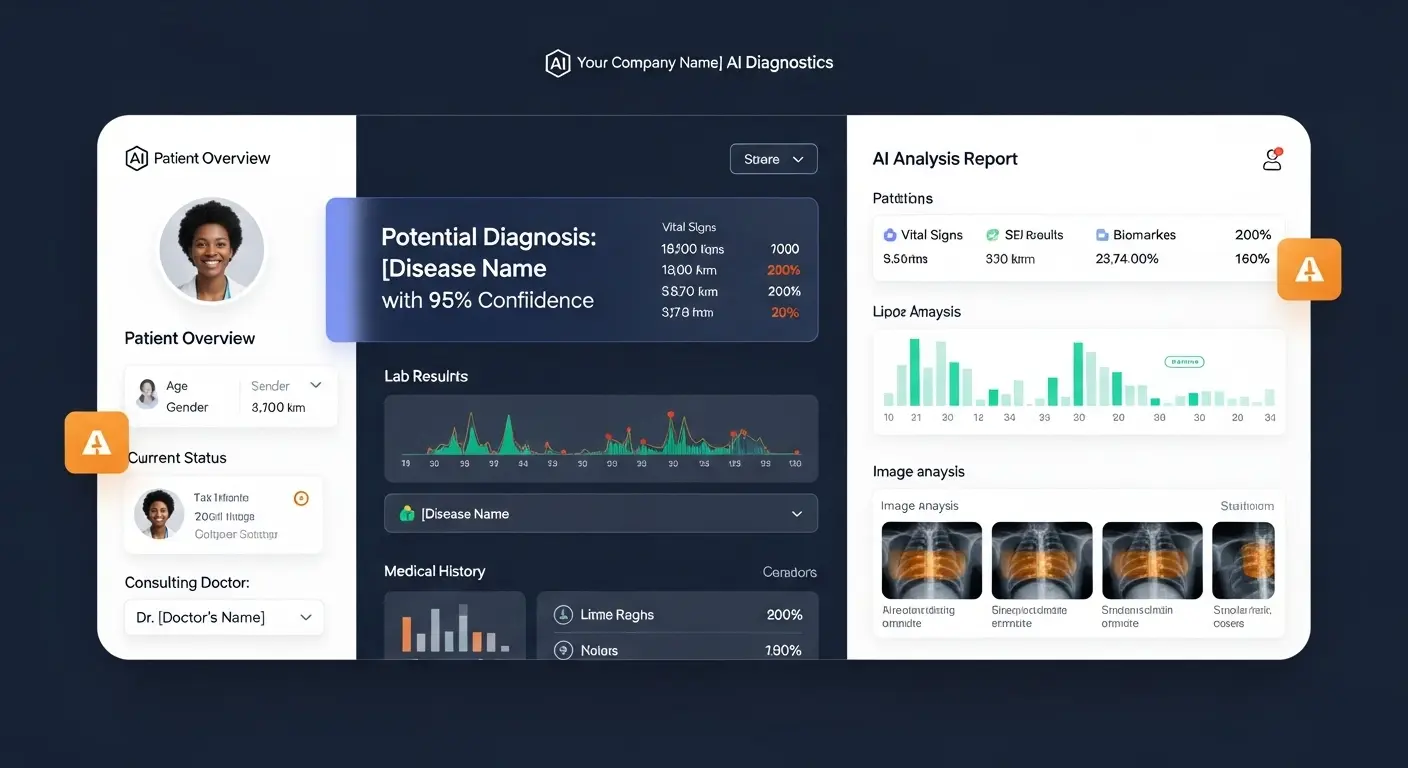
Every prediction comes with attention maps and a confidence score, so clinicians can see why the model flagged something and decide whether to trust it.
What we built
AI-assisted diagnosis
Machine learning models trained for medical image analysis across multiple conditions.
Fast image processing
Analysis of X-rays, MRIs and CT scans with sub-second model response.
HIPAA-compliant data handling
End-to-end encryption and access controls to protect patient records.
EHR integration
Standard APIs and HL7 FHIR support to connect with existing hospital systems.
Explainable results
Attention maps and confidence scores shown alongside every finding.
DICOM support
Reads standard medical imaging formats directly from hospital sources.
Tech stack
- TensorFlow
- PyTorch
- Python
- OpenCV
- DICOM
- React
- Node.js
- PostgreSQL
- Redis
- Docker
- Kubernetes
- AWS
- HIPAA Compliance
- HL7 FHIR
- REST APIs
- WebRTC
How the project ran
- 011 month
Research and planning
Medical literature review, compliance planning and model research.
- 022 months
Data collection and preparation
Dataset curation, annotation and preprocessing pipelines.
- 034 months
Model development
Training, validation and performance tuning of the deep learning models.
- 043 months
Platform development
Web application, APIs and the clinician interface.
- 052 months
Clinical testing
Pilots in partner hospitals, accuracy validation and feedback.
- 061 month
Deployment and launch
Production deployment, staff training and rollout.
Results
The platform reached 95% diagnostic accuracy across multiple conditions and cut diagnosis time from around 30 minutes to about 2 minutes. It is deployed in 50+ hospitals across 3 countries and has processed more than 10,000 patient cases with no data breaches.
Early detection rates for critical conditions improved by 40%, and the platform received FDA breakthrough device designation.
- 95% diagnostic accuracy
- Diagnosis time cut from 30 to about 2 minutes
- Deployed in 50+ hospitals in 3 countries
- 40% better early detection for critical conditions
What is the AI-powered healthcare platform?
An AI diagnostic platform that helps clinicians identify medical conditions by analysing medical images and patient data, with 95% diagnostic accuracy.
What did this project achieve?
We achieved 95% diagnostic accuracy across multiple conditions, reduced average diagnosis time from 30 minutes to 2 minutes, and successfully deployed in 50+ hospitals across 3 countries.
What challenges did you face during development of this project?
Key challenges included medical data privacy compliance (HIPAA), high accuracy requirements for life-critical diagnoses, integration with diverse hospital management systems, real-time processing of high-resolution medical images, training AI models with limited labeled data, and ensuring explainable AI for medical professionals.
How did you overcome the challenges?
We implemented end-to-end encryption with HIPAA-compliant infrastructure, developed ensemble models combining multiple AI architectures, built standard APIs for EHR integration, optimized image processing pipelines with GPU acceleration, used transfer learning and synthetic data augmentation techniques, and created interpretable AI with attention maps and confidence scores.
What was your project timeline?
The project took about 13 months: 1 month of research and planning, 2 months of data collection and annotation, 4 months of model training and tuning, 3 months of platform development and API integration, 2 months of clinical testing in partner hospitals, and 1 month of deployment and staff training.
What technologies did you use?
We used 15+ technologies including TensorFlow, PyTorch, Python, React.js, Node.js, PostgreSQL, Docker, AWS, and more.
What service and support are provided by you after launch?
We provide post-launch support which typically includes bug fixes and updates, performance monitoring and optimization, security patches and updates, feature enhancements based on user feedback, technical support, and ongoing maintenance.
Can you build something similar for our business?
Yes. We would adapt the approach to your data, systems and compliance requirements.
What was the outcome of this project on the client's business?
Diagnosis accuracy improved by 91%, patient wait times dropped by 2.7 hours, and retention rates rose by 59%, saving the client nearly $3.4M a year.
Planning an AI project in healthcare?
Tell us about the clinical problem and the data you have. We will tell you honestly what is feasible and how we would approach it.