
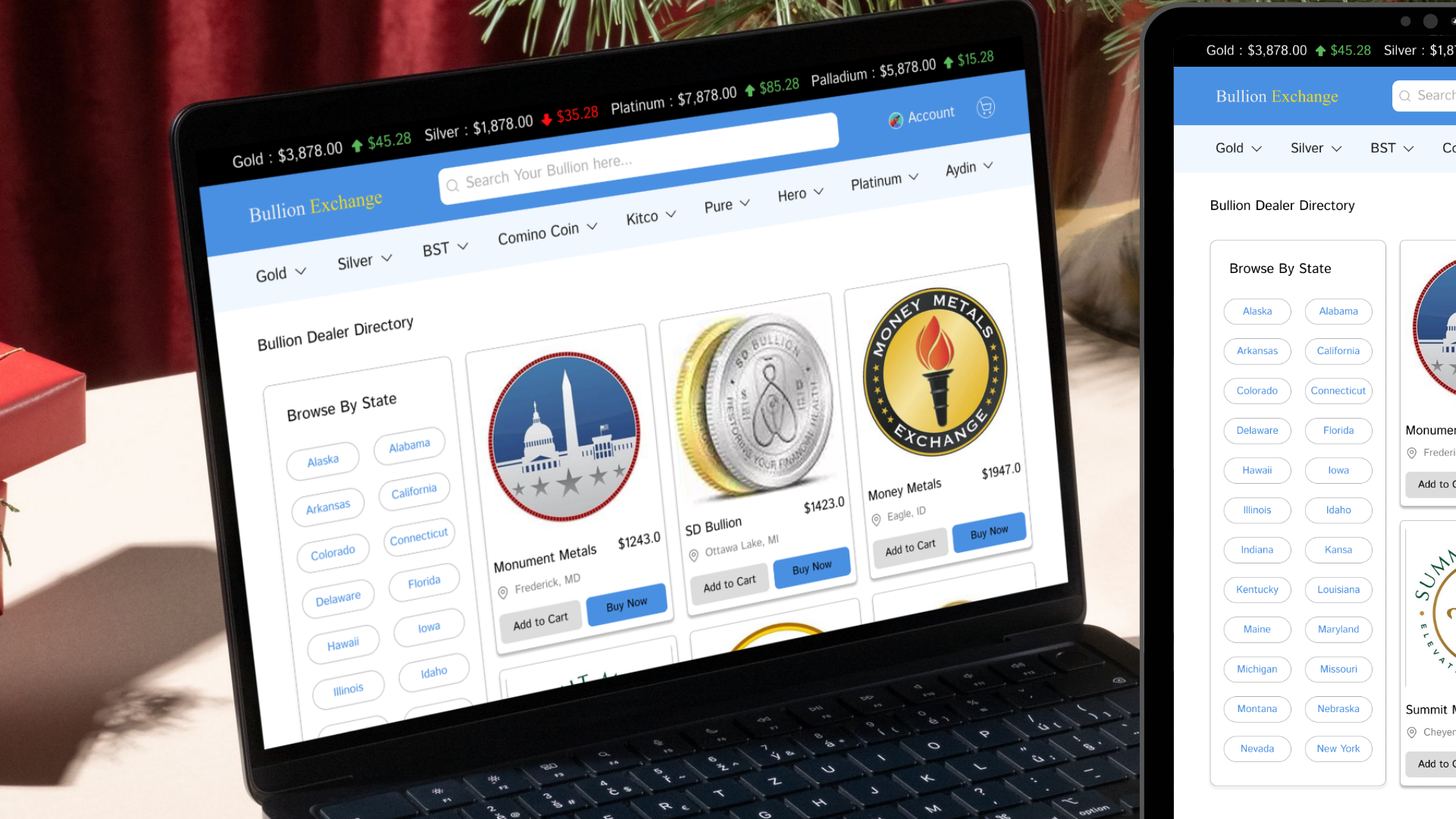
Bullion exchange price scraper
A data system that collects precious metal prices, trends and trading data from 10+ bullion exchanges around the clock and turns them into one consistent feed with alerts.
- Industry
- Finance, precious metals
- Services
- Web scraping, API integration, real-time alerts
- Stack
- Python, Node.js, WebSocket, PostgreSQL
- Timeline
- About 3.5 months
The problem
Investors and traders had to follow bullion prices across many exchanges, each with its own API and data format. Tracking by hand was slow and error-prone, and existing tools could not keep up with how quickly precious metal prices move.
Rate limits, API quotas and uneven data quality made accurate real-time figures hard to get. Without historical data and trend analysis, timing decisions was mostly guesswork.
How we approached it
We built a scraper that pulls prices from 10+ major exchanges through WebSocket connections and REST APIs. A single API layer normalises every source into one format.
Adaptive polling and rate limiting keep the system within each exchange's quotas during volatile periods. Validation checks hold accuracy at 99.5%, and failover keeps the feed running when one exchange has problems.
On top of the feed sit real-time alerts, historical price storage and trend analysis.
What we built
Round-the-clock updates
Prices are tracked and refreshed 24/7 without manual work.
Validated data
Every price passes validation checks, giving 99.5% accuracy.
Multi-exchange coverage
One normalised feed from 10+ exchanges.
Price alerts
Notifications when prices cross the thresholds users set.
Historical data
Stored price history for trend analysis and reporting.
Failover
The feed continues when an individual exchange is unavailable.
Tech stack
- Python
- Web Scraping
- APIs
- PostgreSQL
- Pandas
- Node.js
- WebSocket
- Real-Time Processing
- Data Analytics
- AWS
- Docker
- Scheduled Tasks
How the project ran
- 011 week
Research and planning
Exchange analysis, API research and architecture design.
- 021.5 months
Scraper development
Scraping scripts, API integration and data extraction.
- 031 month
Data processing
Validation, normalisation and the storage pipeline.
- 042 weeks
Real-time system
Live monitoring, alerts and notifications.
- 051 week
Deployment and launch
Production deployment and ongoing monitoring.
Results
The system delivers price updates from 10+ major exchanges 24/7 at 99.5% accuracy. Alerts let investors respond to price movements quickly, and the stored history supports trend analysis and strategy work.
The feed stays available during busy trading periods, and both individual investors and institutional traders now work from the same reliable data.
- 24/7 automated price updates
- 99.5% data accuracy
- 10+ exchanges integrated
- Real-time price alerts
What is the bullion exchange scraper?
It is a data system that collects precious metal prices, market trends, historical data and trading information from bullion exchanges. It normalises the data and adds price alerts, trend analysis and automated reports.
What did the project achieve?
Price updates from 10+ exchanges every hour of the day at 99.5% data accuracy, with real-time price alerts and notifications.
What were the main challenges?
Tracking prices in real time across many exchanges, and keeping financial data accurate and validated.
How did you solve them?
We built real-time monitoring on WebSocket connections and added validation and error checks on every incoming price.
How long did the project take?
About three and a half months across five phases: research and planning, scraper development, data processing, the real-time system, and deployment and launch.
Which technologies did you use?
Python, Node.js, WebSocket, REST APIs, Pandas, PostgreSQL, AWS and Docker, with scheduled tasks for routine jobs.
What support do you provide after launch?
Bug fixes and updates, performance monitoring, security patches, improvements based on user feedback, and ongoing technical support and maintenance.
Can you build something similar for us?
Yes. We can build a price or market data feed around the sources you follow and the alerts you need.
What difference did it make to the client's business?
Price tracking efficiency improved by 86%, with 16,000+ bullion rates monitored daily. Trading volume rose by 209% and profit margins by 43%.
Need market data you can rely on?
Tell us which sources you track and how you use the data. We will suggest a practical way to automate it.