
DeFi trading platform with automated market making
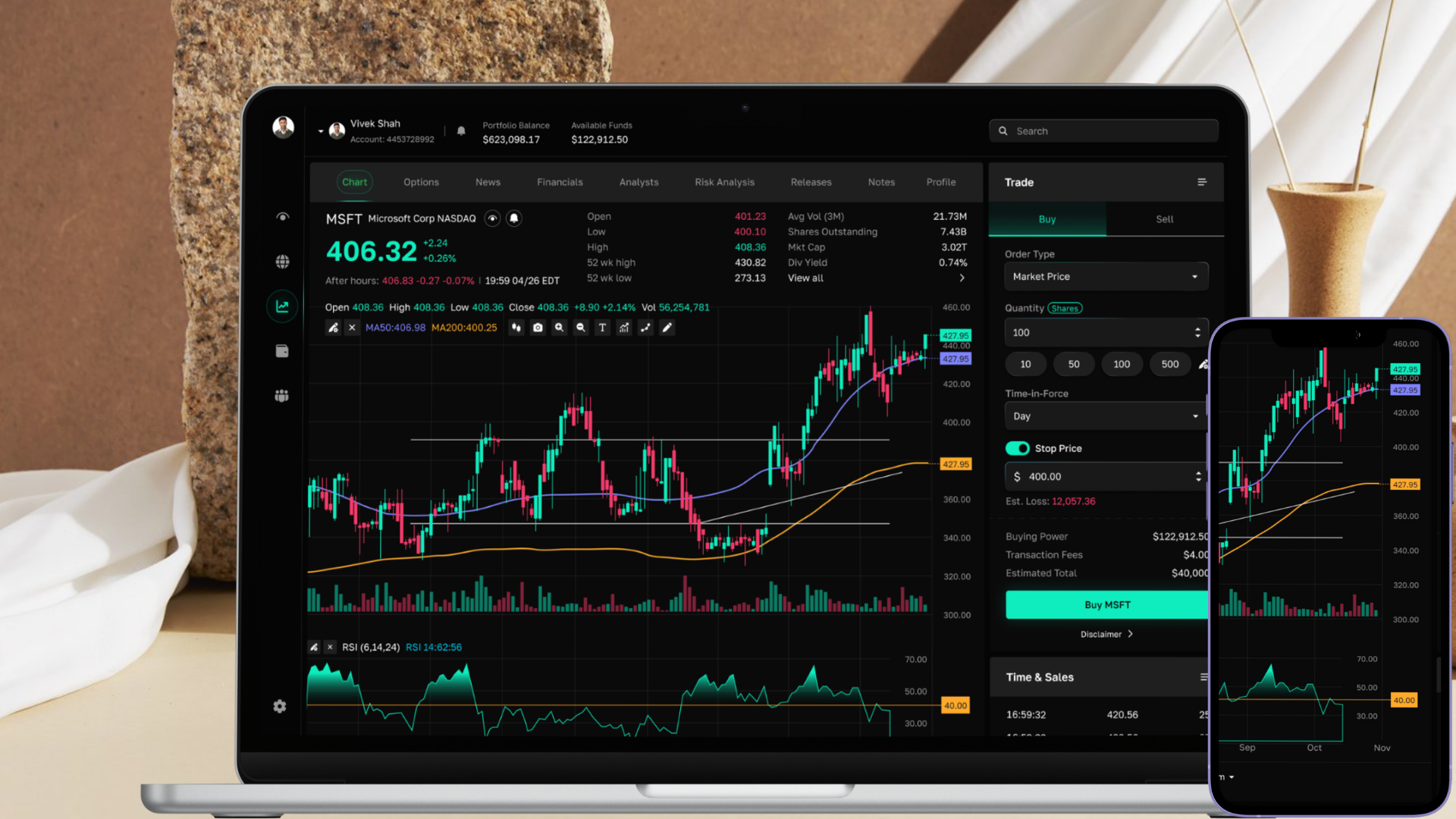
A decentralized finance platform where users trade, stake and earn yield on crypto assets, built on Layer 2 networks to keep transactions fast and cheap.
- Industry
- Finance, decentralized finance
- Services
- Smart contract development, Web3 front end, security audits
- Stack
- Solidity, Ethereum, Polygon, Arbitrum, Next.js
- Timeline
- About 3.5 months to mainnet
The problem
Traditional financial services come with high fees, slow settlement and limited access for many people. Building a DeFi alternative raised its own problems: contracts holding millions of dollars need thorough auditing, and the platform had to serve thousands of concurrent users across several blockchain networks.
Gas costs had to stay low enough for everyday trades, real-time price feeds and liquidity aggregation were hard to get right, and cross-chain operations needed to be reliable enough for users to trust them.
How we approached it
We built on Polygon and Arbitrum as Layer 2 networks to support high-frequency trading with sub-second execution. Custom AMM algorithms with dynamic fees manage liquidity, and Chainlink oracles supply tamper-resistant price feeds.
Multi-signature wallets and flash loan arbitrage detection protect user funds. Market making bots keep liquidity available, and monitoring tracks performance on every network. The interface was designed so newer users can trade and stake without needing deep DeFi knowledge.
What we built
Automated market maker
Custom AMM algorithms with dynamic fee structures for liquidity pools.
Staking and yield farming
Users stake assets and earn yield directly from the platform.
Layer 2 scaling
Polygon and Arbitrum support for fast, low-cost transactions.
Oracle price feeds
Chainlink oracles provide reliable, tamper-resistant pricing.
Fund protection
Multi-signature wallets and flash loan arbitrage detection.
Liquidity bots and monitoring
Market making bots plus monitoring across all supported networks.
Tech stack
- Ethereum
- Solidity
- Polygon
- Arbitrum
- React
- Next.js
- Node.js
- TypeScript
- Web3.js
- Ethers.js
- Hardhat
- OpenZeppelin
- Chainlink
- IPFS
- AWS
- Docker
- PostgreSQL
- Redis
How the project ran
- 012 weeks
Discovery and planning
Market research, architecture design and tokenomics modelling.
- 021 month
Smart contract development
Core protocol, AMM implementation and security testing.
- 033 weeks
Front-end development
Interface design, Web3 integration and responsive build.
- 042 weeks
Security audits
Third-party audits, penetration testing and a bug bounty programme.
- 052 weeks
Beta testing
Closed beta with selected users, performance tuning and fixes.
- 061 week
Mainnet launch
Production deployment, monitoring setup and community launch.
Results
The platform processed more than $20M in trading volume in its first 6 months, kept 98.9% uptime and had no security incidents. More than 10,000 active users in 15 countries use it.
Layer 2 integration cut transaction costs by 70%, the protocol has generated over $1M in fees for stakeholders, and the project won the Best DeFi Innovation award at Blockchain Summit 2024.
- $20M+ trading volume in 6 months
- 70% lower transaction costs
- Zero security incidents
- $1M+ in protocol fees
What is a DeFi trading platform?
A decentralized finance platform where users trade, stake and earn yield on cryptocurrency assets, with automated market making and algorithmic trading.
What are the achievements through this project?
We processed over $20M in the first 6 months, achieved 98.9% uptime with zero security breaches, onboarded 10,000+ active users across 15 countries, reduced transaction costs by 70% through Layer 2 integration, generated $1M+ in protocol fees, and won the Best DeFi Innovation Award at Blockchain Summit 2024.
What are the main challenges in developing a DeFi trading platform, and how did you solve them?
Key challenges include high-frequency trading demands, smart contract security, multi-chain scalability, DEX integration, real-time price feeds, and gas optimization. We addressed these with Layer 2 scaling (Polygon, Arbitrum), custom AMM algorithms, Chainlink oracle integration, multi-signature wallet security, automated market-making bots, and flash loan arbitrage detection systems.
How was your development journey?
We followed a structured multi-phase approach: market research and technical architecture, smart contract and AMM development, front-end design with Web3 integration, third-party security audits and bug bounty program, closed beta testing and performance tuning, and mainnet launch with full monitoring and community rollout.
Which technologies are used in the development of this project?
We used 15+ technologies including React.js, Next.js, Node.js, Polygon, Solidity, Ethereum, AWS, Docker, and more.
Can you build a similar solution for my business?
Yes, we provide similar or customized solutions tailored to your specific business and industry requirements.
Do you provide support and maintenance after launch?
Yes. Post-launch support covers bug fixes, performance monitoring, security patches and feature enhancements based on user feedback.
What business results did the platform deliver?
The platform processed $15M+ in trades in its first quarter, ROI rose by 192% and active users grew by 410% year over year.
Building a DeFi product?
Tell us about the protocol you have in mind. We will talk through contract design, audits and the networks that fit.