
ViA: a self-service builder for AI chatbots and voice assistants
An admin platform where a business enters its details, imports a knowledge base and gets a working chatbot and voice assistant at its own URL, without writing code.
- Industry
- Artificial intelligence, SaaS
- Services
- Platform build, LLM integration, voice pipeline
- Stack
- React, Python, OpenAI API, LangChain, PostgreSQL
- Timeline
- About 3 months
The problem
Businesses that wanted an AI chatbot or voice assistant had to hire specialist developers, integrate several APIs, run infrastructure and maintain it all afterwards. For small and medium businesses the cost and effort were out of reach.
A working assistant needs skills in natural language processing, voice technology, knowledge base management and prompt engineering. Most companies could not spend months of development time to get there.
How we approached it
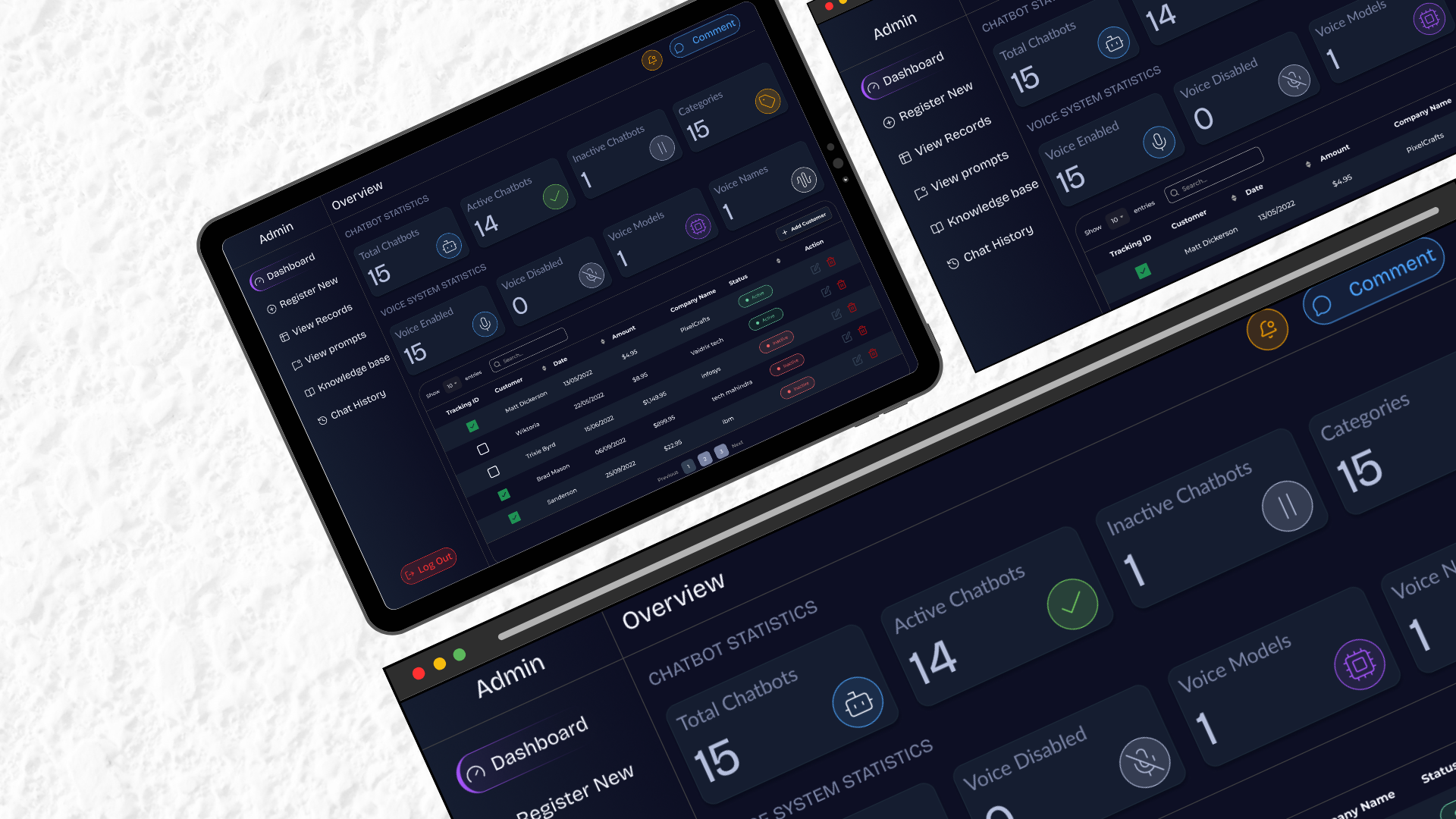
We built ViA (Siddhiva Tech Intelligent Assistance) as a self-service admin panel. A business enters its details, the assistant's name and authorised contact information, then uploads or imports its knowledge base.
Layered prompts let each business keep sensible defaults and override behaviour where needed. Every business gets a unique URL slug that runs its chatbot and voice assistant immediately. Services can be switched on or off, and all conversations are stored for review.
What we built
Knowledge base management
Import and maintain the content the assistant answers from.
Layered prompts
Default prompts plus business-specific overrides to shape tone and behaviour.
Conversation history
Every chatbot and voice conversation stored for review and analysis.
Service toggles
Turn the chatbot or voice assistant on and off as needed.
Unique URL per business
Each business gets its own slug that runs its configured assistant.
Voice pipeline
Speech-to-text and text-to-speech for spoken conversations.
Tech stack
- React
- Python
- TypeScript
- PostgreSQL
- OpenAI API
- WebSocket
- Speech-to-Text
- Text-to-Speech
- Vector Database
- LangChain
- Redis
- Docker
- AWS
- JWT
How the project ran
- 011 week
Planning and architecture
Platform architecture, AI integration design and database schema.
- 023 weeks
AI integration
OpenAI API integration, knowledge base processing and prompt engineering.
- 031 month
Admin panel development
Business configuration UI, knowledge base management and conversation tracking.
- 042 weeks
Voice assistant integration
Speech-to-text, text-to-speech and the voice pipeline.
- 052 weeks
Testing and launch
Platform testing, performance tuning and production deployment.
Results
More than 50 businesses have launched chatbots and voice assistants on ViA. The platform handles thousands of conversations a day with responses in under 2 seconds, around the clock.
Businesses report setup times of 15 to 30 minutes, compared with the 3 to 6 months a custom build used to take. Conversation history shows them what customers ask most, so they can improve their content over time.
- 50+ businesses launched assistants
- Setup in 15 to 30 minutes instead of months
- 10,000+ conversations handled
- Sub-2-second responses
What is ViA (Siddhiva Tech Intelligent Assistance)?
ViA is a self-service admin platform that lets businesses to create and deploy AI-powered chatbots and voice assistants without any technical expertise. Businesses simply configure their settings, upload knowledge bases, customize prompts, and get a unique URL with their intelligent assistant running instantly.
What are your achievements through this project?
Through this project we enabled 50+ businesses to launch their AI assistants, processing 10,000+ conversations daily. The platform reduced setup time from 3-6 months to 15-30 minutes, so businesses of any size can run a conversational AI assistant.
What challenges did you face during development and deployment of this project?
We faced challenges like integrating multiple AI services (OpenAI, speech-to-text, text-to-speech), managing knowledge bases efficiently, creating multilayer prompt systems, and ensuring sub-2-second response times for real-time conversations.
How did you deal with the challenges during development and deployment?
We implemented efficient vector database solutions for knowledge base management, optimized AI API calls with intelligent caching, built a flexible multilayer prompt architecture, and used WebSocket connections for real-time communication to achieve fast response times.
What was the development and deployment timeline of this project?
It was a 3-month project including phases like Planning & Architecture, AI Integration, Admin Panel Development, Voice Assistant Integration, and Testing & Launch.
Which technologies were used for this project?
We used React, Python, TypeScript, PostgreSQL, OpenAI API, LangChain, Speech-to-Text, Text-to-Speech, Vector Database, Redis, WebSocket, and Docker for this platform.
What kind of support and maintenance do you provide after launch?
We provide post-launch support which typically includes bug fixes and updates, performance monitoring and optimization, security patches and updates, feature enhancements based on user feedback, technical support, and ongoing maintenance
Can you provide a similar solution for our business?
Yes. We can build a similar solution tailored to your business needs.
What efficiency gains did the clients achieve through this solution?
Businesses using ViA cut their AI assistant deployment time from 3-6 months to 15-30 minutes, a 99% reduction. They now handle customer inquiries 24/7 with instant responses, gaining valuable insights from conversation history to continuously improve their service.
Want an assistant trained on your own content?
Tell us about your customers and the questions they ask. We will show you what a chatbot or voice assistant could handle.